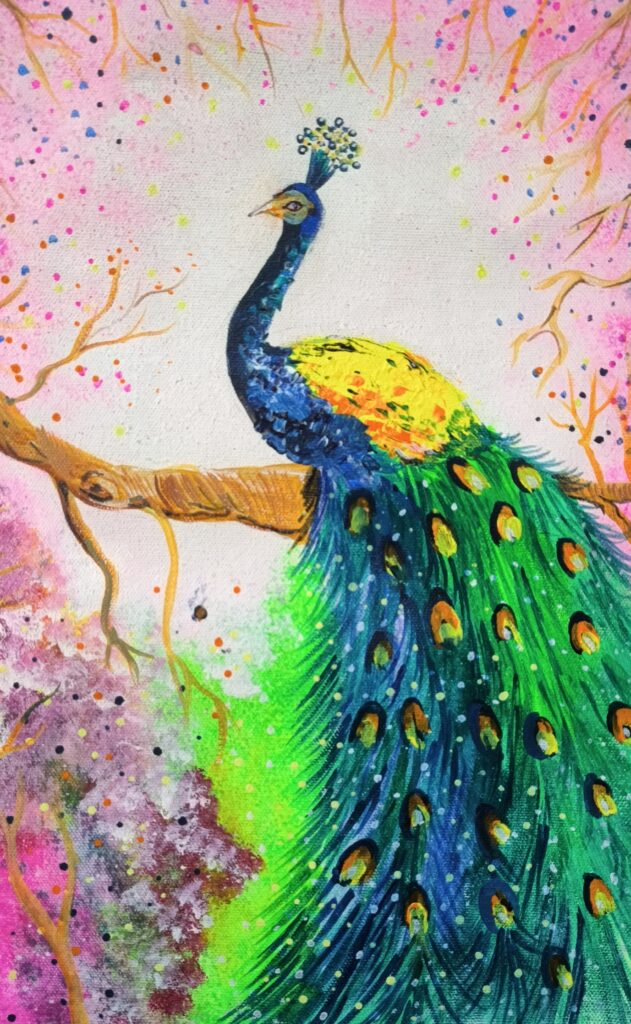
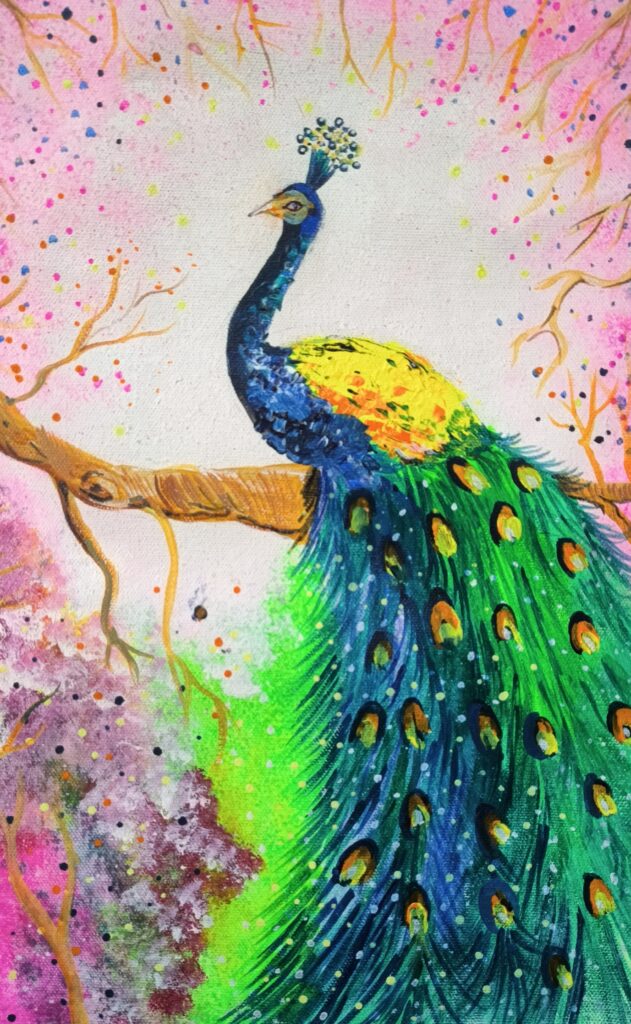
The memory of my first acrylic painting experience is still so fresh in my heart. It wasn’t planned with great knowledge or fancy tools, it was simply born out of pure excitement.
When I decided to make my first acrylic painting, I honestly had very little knowledge about the materials. I did not spend time researching or planning too much-my excitement to paint was much bigger than anything else. I went to a nearby shop and picked up an 18 x 24 inch canvas. From the very beginning, I have always loved working on big sizes, and without thinking whether it was the right choice for a beginner, I just followed my heart and bought it.
Along with the canvas, I also bought a set of Camel acrylic colors and some brushes. At that time, I had no idea about the different brush types or which ones are better for details, strokes, or blending. For me, it was simple: I just wanted to start painting. Looking back, I realize that many artists begin with small canvases to practice, but my excitement made me jump straight into a larger one. In a way, that decision itself reflects my personality-I like to dream big and take on challenges, even if I am not fully prepared.
I remember holding the new brushes and opening the paint tubes for the first time. The fresh smell of colors and the clean white canvas gave me a strange mix of nervousness and joy. It felt like I was about to start a new journey, but at that moment, all I thought about was how beautiful it would be to finally see my imagination come alive on canvas.
The First Brush Strokes & Challenges – My First Acrylic Painting Experience
When I started my very first acrylic painting, all I carried with me was excitement. I had no proper knowledge of materials, no understanding of techniques – just the urge to paint. With that eagerness, I opened my colors and began directly on the canvas. At that time, I didn’t even know what “blending” really meant, or how acrylic paints behaved once applied.
I had planned to make a landscape. I remember laying down the background and trying to merge the shades together. But instead of a smooth blend, my canvas started looking patchy. The colors didn’t mix the way I thought they would. The reason was simple: I had no idea about the tendency of acrylic paints. They dry so quickly that if you don’t move fast enough, your painting starts losing the softness you want. This was a big realization for me that understanding the nature of the medium is just as important as choosing the right subject.
Learning Through Early Struggles
It was frustrating in the beginning. I kept asking myself why the sky in my landscape looked like blocks of color rather than a soft transition. To fix this, I tried adding water, but then the colors became too thin and runny. Going over the patches again and again, only made the canvas look rougher. For a while, I felt like I was failing. But even through that struggle, there was a strange joy. I was discovering something new, something that no one had explained to me before. That first struggle with blending taught me a very important lesson that every medium has its own personality. You cannot force it to behave your way; you have to learn to work with it. Acrylics demanded speed, balance, and smart handling. And with every mistake, I was slowly learning how to handle them better.
Discovering Techniques & Small Hacks
As I continued working, I realized I had to figure out my own little hacks to make things work. Since blending with just a brush was turning out very difficult, I started experimenting with different methods. Sometimes I used my fingers to gently smudge the paint. Sometimes I took a soft piece of cotton cloth and dabbed it lightly to soften the edges. These may not have been the “professional” techniques, but they worked for me. Slowly, I understood that art is not only about strict rules, it’s also about experimenting and finding your own ways to achieve results.
Understanding the Importance of Preparation
Another thing I didn’t know in the beginning was the importance of preparing the canvas. Normally, artists apply a base layer, often gesso, to prime the surface and make it smoother for painting. But at that time, I had no idea about this step. I worked directly on the raw canvas, which made the paint absorb differently in different spots. This added to my struggle because the surface was not consistent. Later, when I learned about priming, I realized how much difference it makes. But in that first painting, I was just trying to figure things out on the go.
What seemed like failures in the beginning were actually my first steps into understanding acrylics. Those so-called “jugaads” of fingers, cotton, and water consistency became my teachers. They taught me that in art, there is no one right way. You can always try, adjust, and discover. Every stroke, every patchy blend, and every uneven surface was slowly building my experience. Looking back now, I feel grateful for those struggles. Because without them, I would never have learned to respect the medium. Those small hacks and adjustments made me realize that mistakes are not something to be afraid of, they are the stepping stones that help you grow as an artist. And most importantly, they taught me that enjoying the process is far more important than chasing perfection.
Conclusion
Looking back, my first acrylic painting experience taught me that mistakes are part of learning and growth as an artist.